Did Abdel Nasser Squander Sudan?
Written by Amr Sabah
Translated by Rozana Sameh
Reviewed by Nada Tamer
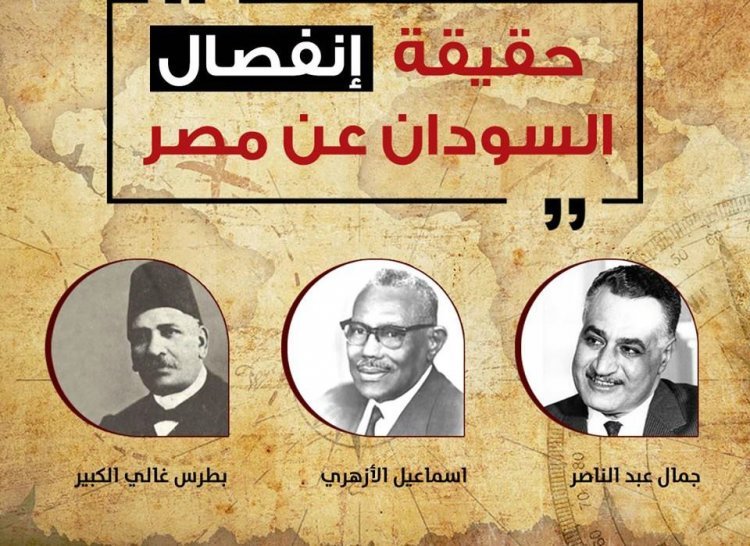
Sudan's separation from Egypt is one of the accusations frequently leveled against Gamal Abdel Nasser and his era. But was Nasser really responsible for Sudan's loss and its separation from Egypt?
Let us review some historical facts;
Seventeen years after the British occupation of Egypt in 1882, the Anglo-Egyptian Condominium Agreement was signed between the Egyptian and British governments on January 19, 1899. At the time, the Egyptian government was headed by Mustafa Fahmi Pasha. The agreement was signed on Egypt's behalf by Boutros Ghali Pasha, the Egyptian Minister of Foreign Affairs, and on Britain's behalf by Lord Cromer, the British representative in Egypt.
Article One of the agreement stipulated that the border between Egypt and Sudan would follow the 22nd parallel north. However, some administrative modifications were later introduced by the Egyptian Minister of the Interior under the pretext of facilitating the movement of the Bashariya tribes of Sudan and the Ababda tribes of Egypt across the border. These modifications later gave rise to what became known as the Halayeb and Shalateen dispute, which continues to be raised periodically by the Sudanese side. Importantly, all of this occurred 19 years before Gamal Abdel Nasser was born.
In 1924, the Egyptian army was expelled from Sudan following the assassination of Sir Lee Stack. At that time, Nasser was only six years old and was about to begin primary school.
In 1937, Mustafa Al-Nahhas Pasha agreed to grant Sudan the right to self-determination. At that time, Gamal Abdel Nasser was nineteen years old and had just enrolled in the Military Academy.
The title "King of Egypt and Sudan" was assumed by King Farouk after the abrogation of the 1936 Treaty in October 1951. However, the title was merely symbolic, as Egypt remained under occupation by 80,000 British troops and hosted the largest British military base in the Suez Canal Zone.
The Sudanese Parliament voted unanimously in favor of separation from Egypt in 1951, a full year before the July Revolution of 1952.
When Mohamed Naguib visited Sudan after the 1952 Revolution, he was greeted by Sudanese crowds who threw shoes at him while chanting:
"Neither Egyptian nor British… Sudan belongs to the Sudanese."
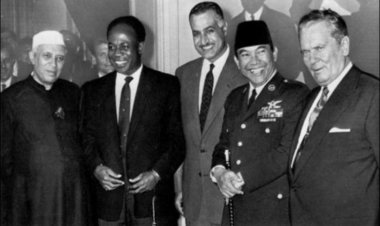
Ismail Al-Azhari, leader of the Sudanese Democratic Unionist Party, was lured by the British with the prestige of the presidency and the prospect of Sudanese independence, prompting him to shift from a unionist position to a separatist one. The events of the Bandung Conference in 1955 clearly demonstrate President Nasser's opposition to Sudan's separation and his attempts to prevent it by every possible means. During the conference, the Sudanese delegation, led by Ismail Al-Azhari and accompanied by Mubarak Zarouq, Hassan Awadallah, and Khalifa Abbas, attended alongside the Egyptian delegation headed by Gamal Abdel Nasser. Nasser objected to the Sudanese delegation participating independently and insisted that they sit behind the Egyptian delegation as part of Egypt. Al-Azhari refused, saying: "We are on the threshold of independence and will become a sovereign state. We must represent the Sudanese people, because this conference represents peoples." Nasser rejected this and told Al-Azhari: "You have no flag to represent you; you must sit behind the Egyptian flag." Immediately, Sudanese delegate Mubarak Zarouq intervened, saying: "We do have a flag." He took a white handkerchief from his pocket, placed it on the tip of his pen, and declared it to be their flag. The Sudanese delegation, led by Al-Azhari, then sat independently of the Egyptian delegation.
Remarkably, this handkerchief is still preserved today and displayed in the exhibition dedicated to the Bandung Conference in Indonesia.
President Nasser reportedly became angry and told Ismail Al-Azhari: "I will not allow you to return to Sudan through Egypt." As a result, the Sudanese delegation returned via Jeddah in Saudi Arabia. Upon arriving there, they did not have sufficient funds to continue their journey to Sudan. The Sudanese community in Jeddah welcomed them and took them to the headquarters of the Dongola Sons' Association, where they arranged and paid for their return tickets to Sudan. When the referendum on unity or separation from Egypt was held, the Sudanese deputies voted unanimously in favor of separation.
In his book Nasser and the African Revolution, Mohamed Faeq, Nasser's special envoy for African affairs, wrote: "Despite Egypt's pursuit of unity with Sudan and its utmost efforts to achieve it, the insistence of the Sudanese on independence eventually compelled Nasser to reluctantly accept the outcome. Egypt thus became one of the first countries to recognize Sudan's independence." Faeq added that this decision had a tremendous impact on Egypt's image in Africa because it respected the doctrine of conquest and instead recognized the Sudanese people's right to self-determination. President Nasser also decided that Egyptian educational and cultural institutions would continue operating in Sudan, and he left Egyptian military equipment as a gift to the Sudanese army. According to Faeq, these measures contributed to the cooperative relationship between Egypt and Sudan. Consequently, when President Nasser decided to build the High Dam, the Sudanese government raised no objections and signed the 1959 Nile Waters Agreement with Egypt.
An excerpt of an Interview with Mohamed Faeq:
Question: What is the truth behind Sudan's separation from Egypt, and how did it occur?
Mohamed Faeq:
Before the Revolution, King Farouk had ceremonially assumed the title of King of Egypt and Sudan, motivated by nationalist support and the historical and familial ties between the two countries. The Revolution, however, adopted a different approach because there was a very large movement within Sudan that opposed unity with Egypt. Britain and the United States supported this movement and encouraged it to demand separation from Egypt. When President Nasser accepted the principle of Sudanese self-determination, the British colonial authorities were astonished.
Nasser accepted this principle because he believed that the doctrine of conquest was no longer compatible with the spirit of the age, despite his firm belief in the importance of unity in the Nile Valley. However, he insisted that such unity must arise from the free will of the people rather than coercion. This principle guided all of Nasser's later unity projects. He consistently emphasized that genuine unity must involve neither coercion nor even the appearance of coercion; rather, it had to be based solely on the will of the people. The primary reason for this approach was Nasser's determination to include Sudan's right to self-determination in the negotiations over British withdrawal from Egypt. He believed Sudan should also be liberated from British colonial rule, since it made little sense for Britain to withdraw from the Suez Canal while remaining in Sudan. Whether Sudan chose unity with Egypt or independence, its security remained of vital importance to Egypt. Had Sudan remained united with Egypt, Egypt would have shared borders with seven additional African territories still under colonial rule, forcing it into a broader confrontation with colonial powers. France controlled Chad and the Central African territories, Britain occupied Kenya and Uganda, and Belgium controlled the Congo.
Nasser also viewed Sudan's security through the lens of its African borders, which drew Egypt into a comprehensive struggle against the old colonial powers. Indeed, following the failure of the 1956 Tripartite Aggression, the British Empire entered its final phase of decline.
Question: After Sudan's separation, did Egypt abandon its strategic depth in the south?
Mohamed Faeq: Absolutely not. Evidence of this is that after 1967, the Military College was transferred to Khartoum, and an airport was also established there. This demonstrates that Sudan continued to serve as Egypt's strategic depth. Revolutionary Egypt worked to establish strong and lasting relations with Sudan and other African countries, contributing to the liberation of many of those countries from colonial rule.
Egypt desired unity with Sudan, but it hoped to achieve it through the will of the people. However, the Sudanese National Unionist Party, led by Ismail al-Azhari, pursued independence. Egypt therefore took the initiative to recognize Sudan as an independent state in order to strengthen friendship and relations between the two countries. It also continued supporting Sudan's independence because it regarded Sudan's security as Egypt's gateway into Africa and an essential base for supporting anti-colonial liberation movements.
Historian Dr. Asim El-Dessouky adds the following context:
- Since Britain's occupation of Egypt in 1882, it imposed its control over Sudan. To appease Khedive Abbas Helmi II and distance him from Mustafa Kamel, Britain signed two agreements governing Sudan jointly with Egypt (January 19 and July 10, 1899). In reality, however, this was purely British rule rather than genuine joint administration. Britain appointed the Governor-General of Sudan, who was always British, while the Khedive merely issued the formal decree of appointment.
- Britain exploited the assassination of General Sir Lee Stack, Commander of the Egyptian Army in Sudan, on November 20, 1924, to expel the Egyptian army from Sudan. Egyptian governments repeatedly demanded the army's return during negotiations with Britain between 1927 and 1936, but without success.
- When Mustafa Al-Nahhas Pasha abrogated the 1936 Treaty on October 8, 1951, together with the Anglo-Egyptian agreements governing Sudan, his government drafted legislation providing for Sudan to have its own constitution, to be prepared by a constituent assembly representing the Sudanese people. What does it mean for Sudan's constitution to be drafted by its own people? Does it imply continued subordination to Egypt, or independence? What was Mostafa El-Nahas’s involvement in this matter?
- In March 1953, Britain made Sudanese independence through a referendum a condition for opening negotiations with the Revolutionary Government over British withdrawal. Could Egypt have refused Sudan's independence when Muhammad Ali had originally annexed it by force in 1822? Would it have been appropriate for a revolution demanding independence for Egypt to deny that same right to the Sudanese people?
Gamal Abdel Nasser sought, by every possible means, to preserve unity between Egypt and Sudan for the benefit of the peoples of the Nile Valley from the very beginning of the Revolution. However, the British had been planning the separation of Egypt and Sudan ever since their occupation of Egypt in 1882, thirty-six years before Nasser was born. They ultimately achieved this objective through Sudanese political leaders and later fostered the North-South divide in Sudan, which eventually led to the creation of the Republic of South Sudan on July 9, 2011, forty-one years after Nasser's death.
Unfortunately, Sudan remains vulnerable to further fragmentation.
References
- In the Aftermath of the Egyptian Revolution, Vols. I & II — Abdel Rahman al-Rafai
- Mustafa Kamel: Founder of the National Movement — Abdel Rahman al-Rafai
- The River War — Winston Churchill
- Memoirs of Salah Salem
- Egypt and Sudan: Separation in Secret Documents — Mohsen Mohamed
- Nasser and the African Revolution — Mohamed Faeq
- The Suez Files — Mohamed Hassanein Heikal
English Language Coordinator: Mariam Essa