Mohammed Naguib’s Role in the Attempt to Assassinate Gamal Abd El Nasser
Written by Amr Sabeh

Translated by Alyaa Hossam
Reviewed by Mariam Essa
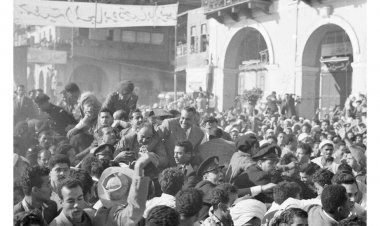
Sixty-five years after the failed attempt to assassinate President Gamal Abd El Nasser in Al Manshia Square in Alexandria, carried out by Mahmoud Abd Al-Latif, a member of the Muslim Brotherhood’s secret armed wing, this incident still holds many mysteries. One of them is the role of President Mohammed Naguib in the incident of Al Manshia and his connection with the Muslim Brotherhood before and after the revolution of 23 July 1952.
Throughout his book "I Was the President of Egypt", President Naguib feels empathy towards the Muslim Brotherhood and defends all its actions. Even describe the assassination attempt against President Gamal Abd El Nasser in Al Manshia in October 1954 as a staged plot prepared by Abdel Nasser and his security services.
During the investigations with the Muslim Brotherhood’s leaders after the assassination attempt against Abe El Nasser in 1954, all the leaders confessed, including those of the Brotherhood’s armed special organization, that they had coordinated with President Mohammed Naguib since April 1954 to assassinate Gamal Abd El Nasser. According to this, President Naguib’s role after the assassination was to take control of the army.
It seems, however, that the relation between President Naguib and the Muslim Brotherhood was much deeper than it appeared and goes back a long way. As the journalist Enas Morshed revealed in an edition of The Radio and Television Magazine; the mysteries surrounding Mohammed Naguib’s relation with the Muslim Brotherhood were revealed by publishing three handwritten letters by him released for the first time on March 18, 2017.
Mohammed Naguib in his three letters wrote his testimony that he is one of the Muslim Brotherhood leaders, one of the participants in choosing its emblem and flag, one of the admirers of the consultation system applied among its members and one of those who wanted to move its headquarters from Ismailia to Cairo to be in the midst of theses events to achieve the greater dream of establishing the Caliphate state.
The testimony appeared in three letters sent by Mohammed Naguib to his friend Mohammed Abo Khalil, the undersecretary of the Ministry of Public Education in Al-Sharqia and a member of the Muslim Brotherhood organization. These letters revolved around three meetings held by the Brotherhood organization, which Mohammed Naguib attended alongside organization pioneers, headed by its founder Hassan El Bana.
The first letter was dated December 15th, 1928, in which Mohammed Naguib expressed his happiness seeing his friend Mohammed Abo Khalil at the meeting of the Brotherhood.
The second letter was dated January 1st, 1929, and included Naguib informing his friend Mohammed Abo Khalil, who had not attended this meeting, what had taken place in it, alongside the discussions about choosing the motto and emblem and about the adoption of the consultation principle within the group.
The third letter was dated January 30th, 1929. Also, Mohammed Khalil had been absent. Mohammed Naguib informed Mohammed Khalil of the discussion regarding the efforts of the Brotherhood organization leaders to move the organization headquarters to Egypt to achieve the goal of establishing the Caliphate state in Egypt and to have King Fuad as the Caliph of the Muslims.
The major general Mohammed Naguib, the man who was chosen by the Free Officers as a representative for their revolution and who turned against them after that, conflicted with them vigorously over authority. He allied with Wafdists and Muslim Brotherhood communists. It ended with him losing and his residence was restricted to Zainab Al Wakeel Palace in Al Marg. He was one of the founders of the Muslim Brotherhood and this interprets his hatred of the July 23rd revolution and his ambition to distort it in his diaries.
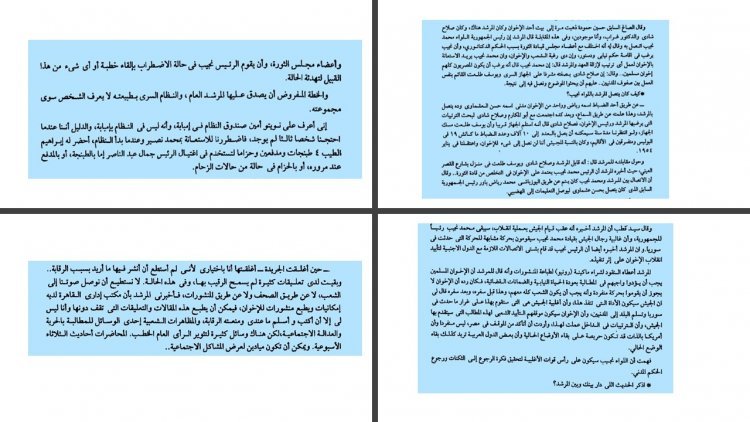
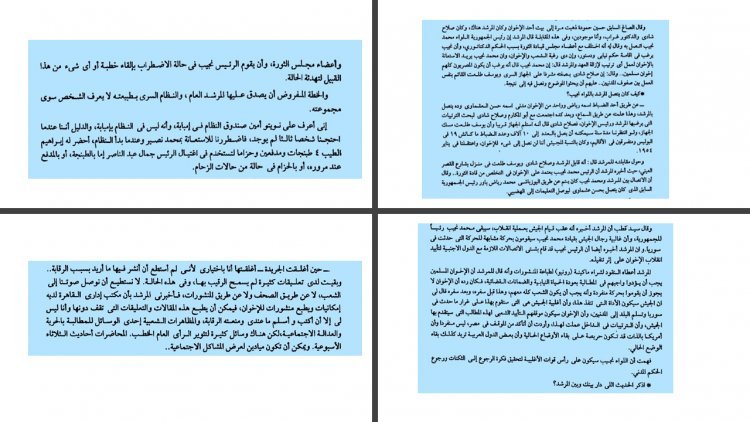
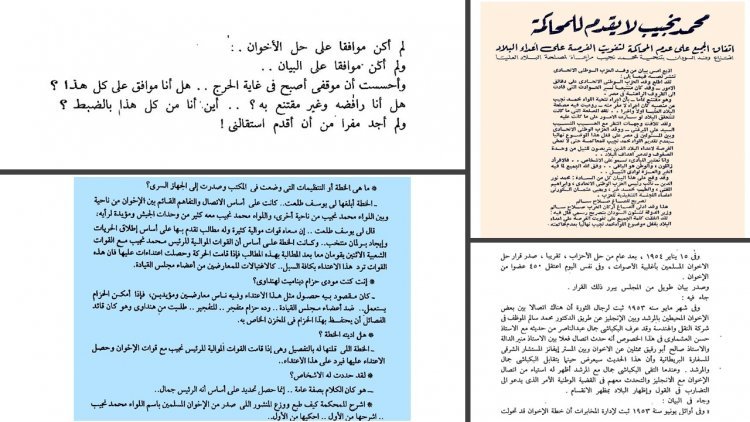
These photos are for the testimonies of the leaders, which are published in the “People’s Court” about President Naguib’s role in the Al Manshia incident. These images present Naguib’s commentary in his memoirs, "I Was the President of Egypt" on the dissolution of the Muslim Brotherhood in January 1954; in addition to the Free Officers’ Council decision not to prosecute him and to limit the penalty to his removal from office.
English Language Coordinator: Mariam Essa