One day…. Abdel-Nasser to Hussein: as long as we didn't sign a peace agreement with Israel, it didn't win the war, and the Americans want to sell us all as Arabs.
Translated by: Menna Tarek
Reviewed by: Nada Tamer
Written by Mr. Said Elshahat
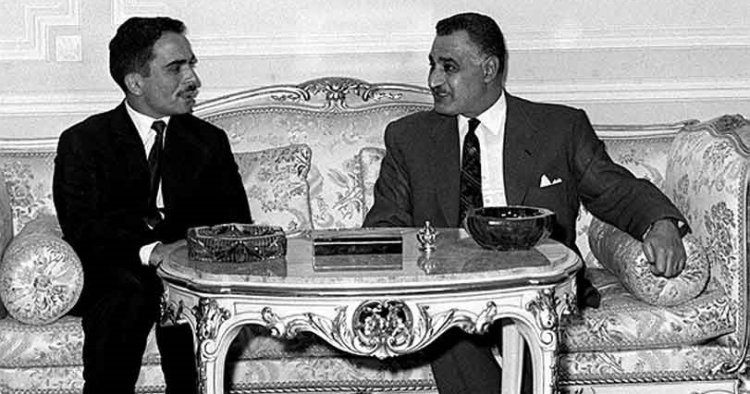
According to Al-Ahram, April 7, 1968, it was six o’clock in the evening on April 6, 1968, when the official discussions began at Al-Qubba Palace in Cairo between President Gamal Abdel Nasser and Jordanian King Hussein.
King Hussein was preceded by the Battle of Karama, which was a heroic epic on March 21, 1968, lasting 16 hours between the Jordanian army and the Palestinian resistance against the Israeli forces, which suffered heavy losses, as about 70 were killed, more than one hundred were wounded, 45 tanks, 25 tracked vehicles, and 27 different vehicles were destroyed, five planes were shot down, and they appealed to stop the fighting.
King Hussein was accompanied by a high-ranking delegation consisting of Crown Prince Hassan, Prime Minister Bahjat Tahlouni, Minister of State for Foreign Affairs Abdel Moneim Al-Rifai, Chief of the General Staff Major General Amer Khammashi, Major General Sharif Nasser bin Jamil, Adel Al-Shamayleh, the Jordanian ambassador to Cairo, and Zaid Al-Rifai. The Secretary-General of the Presidency of the Republic at the time, Abdel Majeed Farid, in his book Minutes of Abdel Nasser’s Arab and International Meetings 1967–1970, reveals the secrets of what happened during the meeting.
It is noteworthy that Hussein began his speech by saying to Abdel Nasser: “Your message to us on the day of the Battle of Karama was the first Arab message we received, and for this reason, we are always proud of you, your positions of struggle, and your pioneering role.” He added: “There is now a trend in Israel that insists on preserving all the Arab lands that it occupied in the war of June 5, 1967, and there are those who call for occupying our lands completely until there is a safe desert between them and Iraq, and another safe desert between them and Saudi Arabia.”
The meeting discussed international moves toward negotiations with Israel, and Abdel Nasser commented on them, addressing King Hussein: “Do we accept going and meeting with the Israelis somewhere, directly or indirectly, and what would be the impact of that after we publicly rejected such a meeting? I respond with regard to the United Arab Republic, Egypt, and say that we cannot accept such a direct or indirect meeting, and do not forget that I only walked with you in the form of the resolution that Jarring, the international envoy, received, despite the opposition of Algeria, Iraq, Sudan, and Saudi Arabia, and I took this position in order to continue political movement. As for America, I thought it would take a different position with you than it did with us, on the basis that there was personal hostility between us and them, and their behavior with you was supposed to be consistent with your position with them as friends. The people here in Egypt want war and reject peace in this way, even though I imagined that the people were fed up and distressed by the abundance of war and the severity of the burdens placed on them. The people here in Egypt have become very sensitive, and the general situation has become very difficult.”
King Hussein said: “The Americans contacted me yesterday to save the Jarring mission from failure, and they advised me to conclude a peace agreement with Israel, and my response to them was that this issue could not be discussed because it was not mentioned in the Security Council resolution.” Then he talked about Jerusalem, his request for weapons from Western sources, the delay in responding to him, and the fact that the Syrians refused to coordinate with him. He also said: “The truth is that the feeling toward the issue in the Arab world varies to different degrees, and if we remain in the Arab world as we are now, the initiative will always remain in the hands of the enemy. We need coordination between us on many matters and a unified position on the issue of international observers on the borders.”
Abdel Nasser replied: “I said what you said now in a public speech. I said that there is no joint Arab plan or Arab coordination, and I believe that many Arab countries want to stay away from any new commitments that they may become involved in. The Syrians asked to establish a joint command with us, so I told them that the joint command must be between them and Jordan and Iraq, and that it is necessary to benefit to the maximum degree from the capabilities of the Iraqi army. There are, of course, doubts between them and Iraq due to partisan matters, but we should exert every effort to establish the Eastern Command. We also must be patient to overcome the internal problems we suffer from, but to accept negotiations with the Jews, directly or indirectly, is unacceptable. Last February, the Americans asked us to restore relations with them, but we declined. We will not restore relations until they clarify their position on the Arab issue by declaring Arab rights, but they refused. The Americans are playing a very despicable game and want to sell us all as Arabs.”
Major General Khammashi reviewed the Jordanian military position, and Abdel Moneim Al-Rifai reviewed the political position. Mahmoud Riad, the Egyptian Minister of Foreign Affairs, spoke, and Abdel Nasser commented, saying after this military and political review: “I would like to repeat that as long as we did not sign a peace agreement with Israel, it did not win the war. The important thing is that we be patient and not despair. Israel’s strategy since the days of Ben-Gurion has been to force us into a solution, and as long as we do not sign any agreement with it, it does not achieve its goals.”
English Language Coordinator: Asmaa Ahmed