Foreign Forces Must Be Completely Withdrawn From Our Lands
Translated by Inga Makary
Reviewed by Mohaned Mohammed
Lord Killearn, the former British ambassador, is leading a campaign against Egypt, composed of those reactionary elements who believe only in enslaving peoples, which is deeply distressing. Whoever thinks that Lord Killearn and his group embarked on this reckless campaign out of concern for the interests of the British people is mistaken. The obvious truth is that this group does not oppose one people over another, but opposes all peoples, including the British people themselves.
People like Lord Killearn seek to mislead the British public into underestimating the fervent national movements not only in Egypt and Sudan, but also throughout the Middle East. We are fully aware and conscious of the distinction between the extreme colonialists and those with privileges, authority, and self-interest among the British, and the British people themselves, whom we see suffering under the burdens of that colonial policy, along with its costs, aggression, and losses.
Lord Killearn is an antiquated type who is entirely out of step with the spirit of the present era, in which equality among peoples has become an established principle that cannot be denied or even debated. He represents those views founded on conquest, invasion, exploitation, and the use of force to impose control over peoples.
Nevertheless, Lord Killearn is a straightforward man. Still, his frankness is of the kind that harms his own citizens, attributing to them selfish and colonial ambitions that British politicians and officials have sought to conceal or deny, simply because he remains influenced by 19th-century, or even earlier, views and theories of international relations.
I quote: “Our grip on the Middle East has begun to loosen” and when discussing the Sudan agreement, he speaks through one of his supporters: “The self-rule of illiterate people (referring to the Sudanese people) is nonsense” meaning that England’s policy toward the Middle East in general, and Egypt in particular, seeks mere domination, and under no circumstances does it want that control to diminish.
His description of Sudan as a country of illiterate people is, in fact, an explicit accusation against the British administration in Sudan over more than half a century; moreover, he contradicts responsible British politicians who always claimed that they aimed to enable the Sudanese to self-rule, thus proving that what they said in this regard did not reflect truth nor reality.
We are not surprised by this campaign against the Sudan agreement, as it stems from anger that people like Lord Killearn were deprived of the symbols and spoils of rule and control in Sudan.
Lord Killearn continues his campaign against Egypt, saying in another article: “We are chasing at a tremendous pace from one place to another, from Abadan, the Suez Canal and Sudan.”
Here, I can only pity the man and his logic, for what he calls a chase is in reality nothing but the victory of patriot movements in this region of the world, whose people can no longer tolerate foreign domination. If the British are chased out of Iran, Egypt, and Sudan, the blame lies with them, as their policy has failed to understand the new spirit in these countries.
The policy glorified by Lord Killearn and his kind runs entirely counter to the vital and real interests of the British people. I don’t need to give examples; the Iranian crisis has cost Britain heavily in financial and moral terms. If this policy had been more enlightened, it would have known how to balance Iran’s just interests with Britain’s reasonable interests.
Killearn warns the British people about Muhammad Naguib and Gamal Abdel Nasser, claiming that we harbor ill will toward Britain! Let it be known that all Egyptians, including us, the leaders of the revolutionary movement, harbor absolutely no ill will, as Killearn claims, toward Britain, the British people, or any other nations. On the contrary, we are a people weary of the evils we have suffered. The Egyptian people, and we are with them, have risen to eradicate evil and replace it with good.
I wish to address the British people themselves, not to mislead them as people like Lord Killearn do, but to reveal the facts so they may be aware of them. I ask: would the British people, if in our position, accept the occupation of their homeland against their will? Would they be convinced by any argument, whatever its form is, to endure continuous foreign occupation if it had lasted seventy years, with promises after promises of withdrawal from their homeland? There is no doubt that any people would reject such a situation, out of concern for their sacred right to full freedom.
Britain bore great burdens to defend its freedom in past wars. It would be no less ready to give and sacrifice. However, our capacity may be greater after enduring over seventy years of enslavement.
We are keenly eager to reach a peaceful settlement, yet at the same time, we are firmly insistent on our rights derived from the natural right of peoples to freedom and independence, which is based on the United Nations Charter. If our hopes are dashed, we will not hesitate, like any people who value their dignity and sacred right to freedom and independence, to pursue any path that secures our rights, regardless of the sacrifices we may have to bear, in order to achieve freedom and leave to our children the greatest possession of a nation: independence and freedom.
I say this briefly but clearly. In this regard, I am just a voice expressing what lives in the hearts of all Egyptians, who will not deviate from their goals under any circumstances: foreign forces must be completely withdrawn from our lands, without any limitation or condition. Once our sovereignty is complete and our freedom absolute, Egypt will know how to repel any aggression that threatens its security.
ـــــــــــــــــــــــــــــــــــــــــــــــــــــــــــــــــــــ
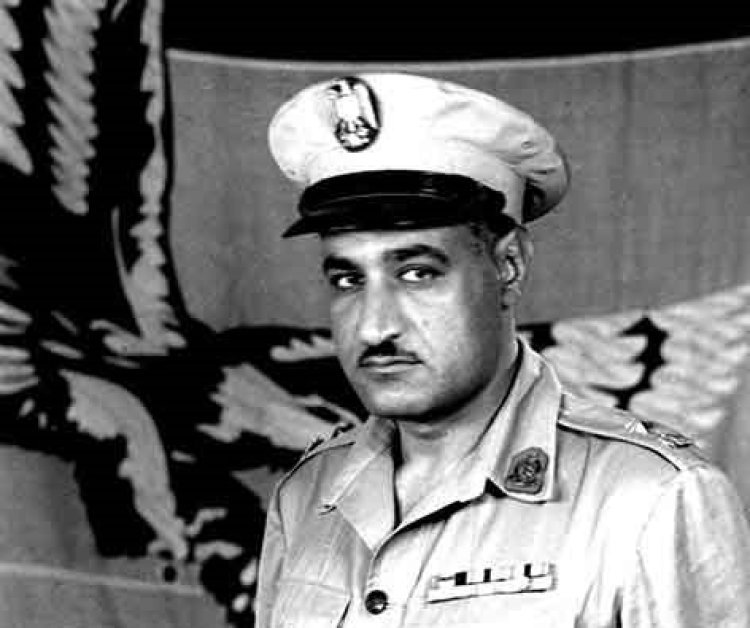
Statement by Lieutenant Colonel Gamal Abdel Nasser to the Editor-in-Chief of the Egyptian News Agency about Britain's campaign against Egypt
On April 5, 1953 AD
English Language Coordinator: Mariam Essa