African Egypt: Abdel Nasser’s Leadership Of The Continent’s Liberation
Translated by: Mahmoud Al-Shafei
Reviewed by: Nada Tamer
Written by Sharif Hasan
Under the leadership of the late President Gamal Abdel Nasser, Egypt played a pivotal role in supporting national liberation movements across Africa in their struggle for independence. The year 1960 became a landmark for African liberation, as 17 nations gained their independence. In that same year, on May 30, 1960, Egypt severed its official ties with the "Union of South Africa". This move came in response to demands from representatives of the South African liberation movement to boycott the apartheid regime and support the establishment of a democratic South Africa ruled by its Black majority.
Mandela in Egypt
In 1961, Egypt hosted the late South African leader Nelson Mandela. Upon his arrival in Cairo, he was accommodated at No. 5 Ahmed Heshmat Street in Zamalek—the headquarters of the 'African Association,' which African diplomats and students in Egypt affectionately called 'The House of Africa.' Mandela’s journey to Egypt was an arduous one; he arrived on foot from South Africa, following in the footsteps of the freedom fighters before him. As a revolutionary whose name was on 'wanted lists' at airports and border crossings, he trekked to South Sudan in a journey that lasted nearly two months. From there, he flew to Egypt, where he was received by Ambassador Mohamed Abdel Ghaffar, the Ambassador Extraordinary to the African Liberation Movement for North Africa and the Arab World.
The visit was kept secret and coordinated with the late President Gamal Abdel Nasser and Mr. Mohamed Fayeq, the Minister of National Guidance (Information) at the time. Fayeq played a prominent role in the political, media, and revolutionary engagement with African nations and liberation movements. The late President Nelson Mandela spent nearly an entire year in Egypt, residing in the same building in Zamalek.
Egypt occupied a significant portion of Mandela’s autobiography, which he began writing in prison and completed after his release. In it, he wrote that Egypt had captured his imagination as the cradle of African civilization and a treasure trove of art and design. He had always yearned to visit the Pyramids and the Sphinx and to cross the Nile, which he described as the greatest river in Africa. Mandela also recalled traveling from Addis Ababa to Cairo with his comrades, Oliver Tambo and Robert Resha. He spent his first day at the Egyptian Museum, examining artifacts and taking notes on the men who founded the ancient Nile Valley civilization. His interest was that of an amateur archaeologist, driven by the belief that Africans must arm themselves with evidence to refute white claims that Africa lacked a civilization comparable to the West. Mandela remarked, "In a single day, I discovered that Egyptians were creating great works of art while Westerners were still living in caves."
Egypt and South Africa After The Liberation from Apartheid
Following his release in February 1990, the freedom fighter Nelson Mandela chose Egypt as the first country to visit. The streets were filled with Egyptian and African supporters of all ages, as Egypt welcomed him as a global icon of struggle and a symbol of the fight for freedom.
Following the general elections in South Africa in April 1994, the Egyptian and South African governments announced the upgrading of their diplomatic missions to the level of embassies. That same year, the Egyptian Foreign Minister at the time, Mr. Amr Moussa, attended the inauguration ceremony of Nelson Mandela, the first democratically elected president of South Africa after the end of the apartheid regime.
The year 1995 witnessed the establishment of a joint cooperation committee between the two nations, which held its first session in Cairo in April 1996. During the session, both sides agreed to boost bilateral relations across all fields, particularly in trade. This included opening South African markets to Egyptian products and expanding the participation of Egyptian companies in annual exhibitions held in South Africa.
However, Gamal Abdel Nasser’s regional standing shifted unexpectedly when Yemeni officers, led by the pro-Nasser Abdullah Al-Sallal, overthrew Imam Al-Badr in North Yemen on September 27, 1962. Al-Badr and his loyalist tribes began receiving increased support from Saudi Arabia to restore the monarchy, while Nasser—at Al-Sallal’s request—committed military aid to the new government on September 30. Consequently, Egypt became increasingly embroiled in the protracted Yemeni Civil War until it withdrew its forces in 1967. Most of Nasser’s longtime colleagues questioned the wisdom of prolonging the war, but Field Marshal Amer assured him of an imminent victory. Nasser later remarked in 1968 that the intervention in Yemen had been a "miscalculation."
In July 1962, Algeria gained independence from France. As a staunch political and financial supporter of the Algerian independence movement, Nasser viewed the country’s liberation as a personal victory. Amid these developments, a pro-Nasser faction within the Saudi royal family, led by Prince Talal, sought refuge in Egypt, along with the Jordanian Chief of Staff, in early 1963.
Nasser and Yemeni President Abdullah Al-Sallal Greeting Crowds in Sana'a, April 1964.
On February 8, 1963, a military coup in Iraq, led by a Ba'athist-Nasserist alliance, overthrew Qasim (who was later killed). Abdul Salam Arif, a Nasserist, was chosen as the new president. A similar alliance toppled the Syrian government on March 8. By March 14, the new Iraqi and Syrian governments sent delegations to Cairo to pressure Nasser into forming a new Arab union. During the meeting, Nasser criticized the Ba'athists for "facilitating" Syria’s secession from the United Arab Republic (UAR) and asserted his role as the "Leader of the Arabs." A transitional federal system was agreed upon and signed on April 17, with the new union scheduled for May 1965. However, the agreement was later scrapped after the Syrian Ba'athists purged Nasserist officers. Following a failed counter-coup by a Nasserist colonel, Nasser famously labeled the Ba'athists as "fascists."
In January 1964, Nasser convened an Arab League summit in Cairo to organize a unified response against Israel’s plans to divert Jordan River water for economic purposes, an act Syria and Jordan viewed as a provocation for war. Nasser blamed Arab divisions, describing the situation as "catastrophic." While he encouraged Syria and Palestinian Fedayeen against Israeli provocations, he stated that he was not planning for war with Israel. During the summit, Nasser initiated friendly ties with King Hussein and mended relations with the rulers of Saudi Arabia, Syria, and Morocco. In May, Nasser formally assumed a leadership role in the Palestinian cause by initiating the establishment of the Palestine Liberation Organization (PLO), using it to coordinate the Palestinian Fedayeen. Its first chairman (and Nasser's personal nominee) was Ahmed Shukeiri.
After years of foreign policy coordination, Nasser, along with Presidents Sukarno of Indonesia, Tito of Yugoslavia, and Nehru of India, founded the Non-Aligned Movement (NAM) in 1961. Its declared goal was to solidify non-alignment, promote global peace during the Cold War, eradicate colonialism, and increase economic cooperation among developing nations. In 1964, Nasser became the Chairman of the NAM and hosted its second conference in Cairo.
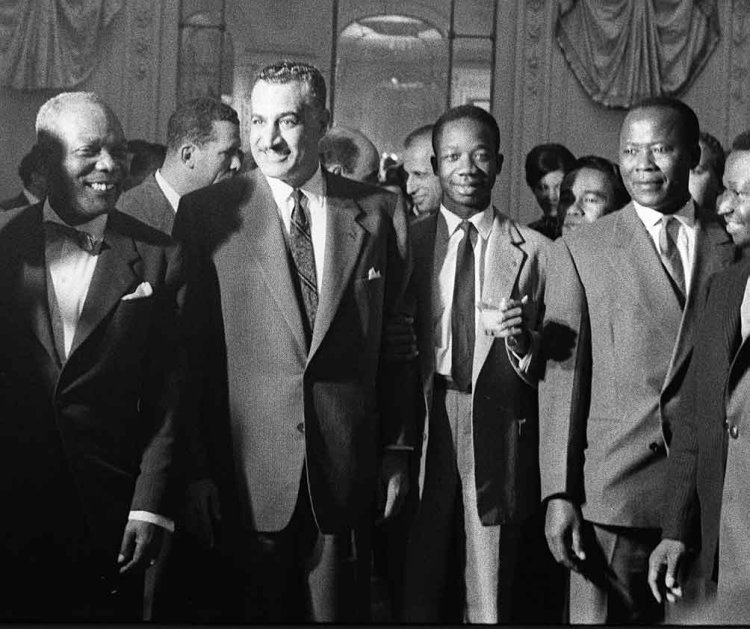
Nasser played a vital role in fostering African solidarity during the late 1950s and early 1960s. During this period, he turned Egypt into a haven for anti-colonial leaders and allowed many African nations to broadcast anti-colonial propaganda from Cairo. Starting in 1958, Nasser was a key figure in discussions among African leaders that eventually led to the establishment of the Organization of African Unity (OAU) in 1963.
English Language Coordinator: Mariam Essa