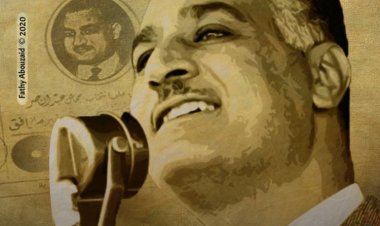
Leader Abdel Nasser: A Figure Whose Historical Stances Remain Unforgettable
Translated by: Shams Yousry
Reviewed by: Mariam Essa
By Mohamed Salah El-Din
Gamal Abdel Nasser was born on January 15, 1918, in a modest mud-brick house on Qanawat Street in the Bakos district of Alexandria. Abdel Nasser hailed from a family of Upper Egyptian origin; his father was born in the village of Beni Mur in Asyut. He was the firstborn child, followed by his two younger brothers, Ezz Elarab and Ellaithy.
Gamal Abdel Nasser is considered the second president of Egypt after the fall of the monarchy. He was one of the key leaders of the July 1952 Revolution, which overthrew the rule of King Farouk, and he remains one of the most prominent Arab leaders who believed in the cause of Arab Nationalism. Returning to Abdel Nasser's formative years, his biographers, such as Robert Stephens and Said Aburish, recount that the Nasser family were passionate believers in the concept of Arab Glory. This conviction is evidenced by the name of Nasser's brother, Ezz Elarab, which literally means glory/pride of the Arabs, a name rarely encountered in Egypt.
The Start of the Struggle
Abdel Nasser joined students who were protesting a statement by a British Minister that the 1923 democratic Constitution was inapplicable. It is reported that many fatalities and numerous other casualties occurred in those demonstrations. These protests paved the way for the 1923 Constitution to return and for the 1936 Anglo-Egyptian Treaty to be signed.
In 1936, Nasser enrolled in the Military Academy, which included students from the middle classes after previously being restricted only to the rich, thanks to the Wafd Party. After graduating from the Military Academy with the rank of Second Lieutenant, Abdel Nasser was sent to Assiut, then to Sudan. as a was sent to Assiut and then to Sudan.
The 1948 British encirclement of the King’s palace, forcing him to fire his Prime Minister, Ali Maher, and appoint Nahas Pasha, caused a profound sense of bitterness among the officers who contributed to liberating the country.
The Palestine War and its Role in Shaping his Character
The 1948 Palestine War contributed to the formation of his character, which he always considered the foremost Arab cause until his death. Abdel Nasser saw the great solidarity the Palestinian cause received as a major foundation for establishing the Arab Unity that he constantly called for. It is noted that Abdel Nasser participated in the Palestine War and achieved a significant victory in the village of Al-Faluja, but this did not change the course of the war.
Unforgettable Stances
The Non-Aligned Movement:
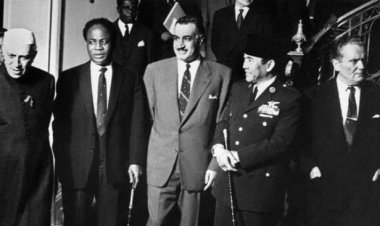
The basis of the Non-Aligned Movement is attributed to President Nasser, Indian Prime Minister Jawaharlal Nehru, and Yugoslav President Tito. The movement aimed to stay clear of the scourge of the Cold War and the losses it caused in lives and money.
It was formed of 29 states, which attended the Bandung Conference of 1955. This conference is considered the first organized gathering of the movement. The first conference of the movement was held in 1961 in Belgrade, attended by representatives of 25 states. The conferences for the movement continued until the last conference in 2012. The number of members in the movement reached 118 states in 2011.
Nationalization of the Suez Canal:
On July 26, 1956, the late leader announced the nationalization of the Universal Company of the Maritime Canal of Suez, an Egyptian joint-stock company. This company had monopolized the Suez Canal since it was dug in 1869, as Egypt, the canal's owners, had no notable role. Despite the huge revenues the Canal generated, Egypt only received a share of 1 million pounds sterling out of 34 million pounds sterling. The nationalization of the Canal was a strong response to the World Bank, which had refused to finance the High Dam project after long discussions of that same year.
Supporting Liberation Movements in Africa
Following the July 23, 1952, Revolution, Egypt helped establish the “Organization of African Unity,” which was based in Addis Ababa, the Ethiopian capital. This was later followed by the “Coordination Committee for the Liberation of Africa” to support liberation movements across the African continent.
Egypt also sent peacekeeping forces to the Congo, in addition to supporting the Mau Mau uprising in Kenya against the British occupation. Egypt provided great support to the uprising's leader, Jomo Kenyatta. Furthermore, Egypt strongly opposed the apartheid policy in South Africa under the leadership of Nelson Mandela.
In 1962, Egypt, led by the Leader, participated in founding the “Coordination Committee” for the Liberation of Africa. Egypt also provided African countries with material and military supplies, as well as opening military training centers, which helped create significant military cadres.
Egypt has provided African nations with media offices and political headquarters. The number of these offices and headquarters reached around 19, and they performed their duties fully.
English Language Coordinator: Asmaa Ahmed