Smoke Rising From The Engine...Should We Be Concerned?
Translated by Menna Tarek
Reviewed by Mariam Essa
Written by Yasser Abu Mualliq
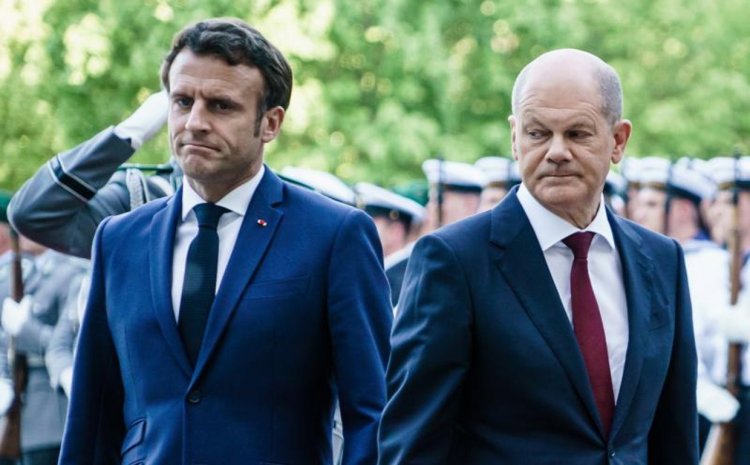
Cracks are beginning to emerge between Europe's two largest economies, dubbed as the "engine of the European Union": Germany and France.
We start with the trigger:
Last week, the annual German-French consultative meeting was supposed to be held in person for the first time since the outbreak of the COVID-19 pandemic. But the Elysee Palace announced its cancellation due to a strange German justification: the date conflicted with the vacations of some German ministers!
This meeting is supposed to discuss vital issues and comes amid a major European crisis and a war on the verge of war, but it was cancelled because five German ministers, including Foreign Minister Annalena Baerbock, want to spend their autumn holidays?!!
Let's take a look under the hood of this engine:
Since Olaf Scholz took office as Chancellor of Germany, signs of a rift have emerged between him and French President Emmanuel Macron, exacerbated by the consequences of the Russian-Ukrainian war.
Currently, there are two main issues on which Paris and Berlin disagree: energy and defense:
1- Energy
While the French President supports the European Union's efforts to launch a joint support package for energy prices, Chancellor Schulz chose the individual path and announced a special package for Germany to support energy prices of about 200 billion euros, without informing Paris in advance!
This huge package would negatively affect the rest of the European countries that are less able than Germany to borrow to stabilize their energy prices. Such a huge amount would allow Germany to buy the energy it needs at any price, which would consequently mean higher energy prices for other countries.
However, there is some speculation that part of the German move comes in response to France's rejection of a proposal to extend the Midcat gas pipeline through its territory to Germany. This line connects Algeria to Spain, and its extension to Germany is accepted by Germany, Spain, and Portugal. But the French rejected it on the grounds that they did not want to invest in natural gas infrastructure and that they preferred nuclear energy (which the Germans reject).
2-Defense:
For years, French President Macron has been calling for what he calls "European strategic independence" and freedom from military dependence on the United States. Indeed, we should not forget that this demand has a profit perspective, because that will mean the revival of French military industries as an alternative to American ones.
The war in Ukraine has led most European countries to increase their military spending, led by Germany, which approved a support package worth 100 billion euros to balance the German army (Bundeswehr). But instead of spending these 100 billion on developing European military industries (as Macron wants), most of it will go to buying American military equipment, especially stealth F-35 fighters.
Above all, France is upset that it has not been involved in an initiative led by Germany and 14 countries in the North Atlantic Treaty Organization (NATO), called the "European Sky Shield Initiative", which will depend on purchasing large quantities of American and Israeli air defense batteries. France wants to invest this money in developing European defense infrastructure, rather than purchasing equipment from the Americans or others.
French sensitivities are understandable, given that long-term solutions and investment in encouraging national industries will yield significant benefits; still, for other European countries, including Germany, it does not solve immediate concerns. Therefore, they prefer quick solutions with immediate effect, even if they cost them dearly.
There's smoke starting to rise from the "Europe Engine". Will the Europeans, however, succeed in reforming it or will the Germans and French sit at the same table and solve their problems before it is too late?
This is what we will know next year, maybe!
English Language Coordinator: Mariam Essa