Dr. Ali Al-Hafnawi Writes: 195 Years Ago, Egypt and Greece...
Translated by Shams Yousry
Reviewed by Mariam Essa
Written by Dr. Ali Al-Hafnawi
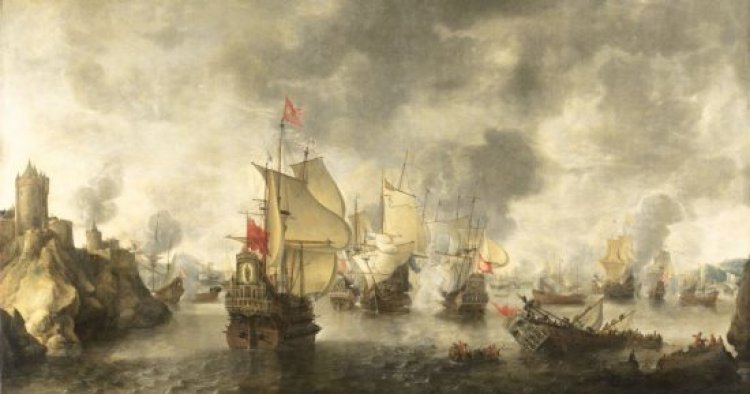
About 195 years ago, on 20 October 1827, the last major naval battle of the age of sailing ships took place. The battle was led by the Egyptian fleet, with some units from the Ottoman fleet and others from Tunisia. On the other side were the fleets of Britain, France and Russia. This was the well-known Battle of Navarino, which took place off the coast of Greece, specifically at the entrance to the Peloponnese Peninsula, opposite the capital, Athens.
This raises several questions: What was the Egyptian fleet doing in Greece? Why did it fight against the fleets of three of the greatest powers at that time? And what was the result?
After the Ottoman invasion of the territories of the Byzantine (Eastern Orthodox) Empire in the twelfth century, the Greek islands, present-day Greece, remained independent for a period until they fell under Ottoman rule during the fourteenth and fifteenth centuries. Then, Greece remained an Ottoman (Muslim) territory for three centuries until uprisings began demanding independence in 1821. The Greeks even declared their independence in January 1822, before their lands were fully liberated.
Ottoman Sultan Mahmud II sought Muhammad Ali, the ruler of Egypt, asking for military support to suppress the Greek uprising. In 1824, Muhammad Ali sent Egyptian military forces under the command of Ibrahim Pasha. At first, the force consisted of 8,000 soldiers, followed by an additional 25,000 soldiers. The intervention of the Egyptian army was decisive in crushing the Greek revolt and restoring control over all Greek territories, including Athens, which Ibrahim Pasha entered victoriously in 1827. (It is worth mentioning: Muhammad Ali and his adopted son, Ibrahim Pasha, were born and raised in Kavala, Greece.)
While Metternich, a dominant Austrian diplomat and statesman, was not enthusiastic about supporting the Greek War of Independence because its slogans leaned toward liberal ideas. Russia discerned promoting revolution as an opportunity to control the Bosphorus Strait and expand its influence southward, claiming to defend the Orthodox faith. France’s stance, however, was less rational. Despite backing non-liberal movements in Spain, France chose to side with the Greeks because they were Christians fighting Muslims. French intellectuals considered this stance to be influenced by the remnants of the Crusades’ philosophy, which were still rooted in the minds of French leaders. As for Britain, its main concern was dominating the eastern Mediterranean to protect the route to India, especially as some studies had already begun to promote the idea of digging the Suez Canal in Egypt.
The commanders and officers of the Western fleets stationed near Greece were enthusiastic about backing the Greek liberation movement, despite claims of neutrality advocated by their governments. In July 1827, the Treaty of London was signed after the Greek rebels had retreated in the face of Ibrahim Pasha’s forces gaining control over much of the country. The treaty included an indirect threat by the three major powers to the Ottoman sultan, as well as a warning that they would acknowledge Greek independence if the fighting executed by the Egyptians in Greece did not end. The agreement also contained a secret clause, later revealed, calling for the three powers to intervene in order to separate the fighting forces in Greece.
The Greek government accepted the ultimatum on September 2, while the Ottoman Sultan rejected it, relying on the power of the Egyptian and Ottoman fleets in the Mediterranean when compared to the lesser fleets of France and Britain.
As it was psychological warfare, the British spread rumors among the Greeks that Ibrahim Pasha’s plan for Greece was to deport all Greeks to Egypt as slaves and replace them in Greece with Muslim Egyptians. These rumors had a strong effect on intensifying the Greek resistance movement.
After the signing of the Treaty of London, Britain and France tried to neutralize Muhammad Ali and persuade him not to support the Ottoman sultan. For this purpose, the ambassadors of both countries visited him in Alexandria. This visit was after knowing that Muhammad Ali had sent an additional fleet of 90 ships. This fleet was led by Muharram Bey to support the Egyptian fleet and the Egyptian army forces under the command of Ibrahim Pasha in Greece. However, Muhammad Ali refused, as this would mean cutting all ties with the Ottoman Sultan and he was not willing to do so at that time.
Some Greek ships sought to escalate the circumstances in order to place the Egyptian–Ottoman fleet under fire from the British and French ships. As a result, several clashes took place during September. The circumstances intensified before any direct intervention by the Western fleets. On October 10, the Russian fleet joined the British and French fleets to blockade Ibrahim Pasha and the Egyptian–Ottoman fleet in Navarino Bay.
Ibrahim Pasha decided to position his fleet of 90 warships of various sizes inside the bay in a horseshoe formation to intimidate the attacking fleets, which were smaller in terms of numbers. He also secured land with cannons placed on the high hills on both sides of the bay’s entrance. As a result, Egyptian military forces consisted of more than 3,500 cannons and around 30,000 naval soldiers. The Ottoman fleet was led by the ship Guhu Raya, equipped with 74 cannons, while the Egyptian fleet was led by the ship Murshid al-Jihad, equipped with 60 cannons and commanded by Muharram Bey.
A rather ironic detail is that the Egyptian fleet included some French advisers who had assisted in building the fleet. The French admiral, Rigny, instructed them to move away from the warships to avoid being hit. They left their ships with the help of an Austrian landing vessel. However, one French officer, Captain Lautollier, remained on board the flagship with Muharram Bey until the battle broke out on October 20. He assisted Muharram Bey in reaching the shore when their ship was hit.
Neither Ibrahim Pasha nor any Ottoman commander intended to start a battle. They believed that the number and positioning of their ships in the bay would prevent any enemy vessel from entering, out of fear of the large fleet ready for combat.
However, the opposing commanders decided to enter the bay. On October 20, 1827, before sunset, the British, French, and Russian ships sailed into the bay; took positions within the horseshoe formation; lowered their sails; and dropped their ship anchors, with everyone expecting a round of negotiations between the sides. But what happened next was unexpected. One of the small ships at the entrance of the bay, believed to be Tunisian, fired a defensive cannon shot, thinking that the ship in front of it was aiming its cannons to strike it.
Cannons fired from all directions and the close proximity of the ships added to the chaos. Smoke rose, sails and rigging fell and men were killed on both sides for a full four hours. The night passed with a few scattered, minor incidents. Sunlight made the scale of losses crystal clear: the Egyptian and Ottoman fleets had suffered massive damage, while the losses among the other fleets were limited. Victory did not rely upon numbers but on the strength of the artillery, the sturdiness of the ships and skillful command during the battle.
On the evening of October 25, Ibrahim Pasha went to meet the British and French commanders. He agreed to their instructions to evacuate the remainder of his fleet to Egypt, but he refused to leave Greek territory. On the same day, the British, Russian, and French fleets withdrew from Navarino Bay. The rest of the Egyptian fleet left for Alexandria at the beginning of December, leaving Ibrahim Pasha and his army on Greek soil. They did not withdraw until September 9 of the following year, following an agreement signed between Muhammad Ali and Britain on August 28 to evacuate the Egyptian forces.
Of the 40,000 members of the Egyptian army in Greece, only 221,000 returned to Egypt after a large portion of them were killed in the naval Battle of Navarino on October 20, 1827. This leaves us to wonder: What did Egypt gain?
As for Greece, it gained acknowledgement of its independence by major powers in 1830.
English Language Coordinator: Mariam Essa