A Partner, A Commercial Competitor and A Political Rival
Translated by: Salma Hussein
Reviewed by: Mariam Essa
Written by Yasser Abu Mualliq
This is how the European Commission's paper defines the European Union’s stance toward China: China is the European Union’s largest trading partner, a major source of rare minerals and required materials for Europe’s advanced industries, as well as a hub of technologies that China has come to monopolize, especially in the renewable energy field.
Furthermore, China is a commercial competitor to EU economies that rely on exports and services. Moreover, China is viewed as a rival to European democratic systems of governance, since it offers an alternative political model that it seeks to promote, according to the European perspective.
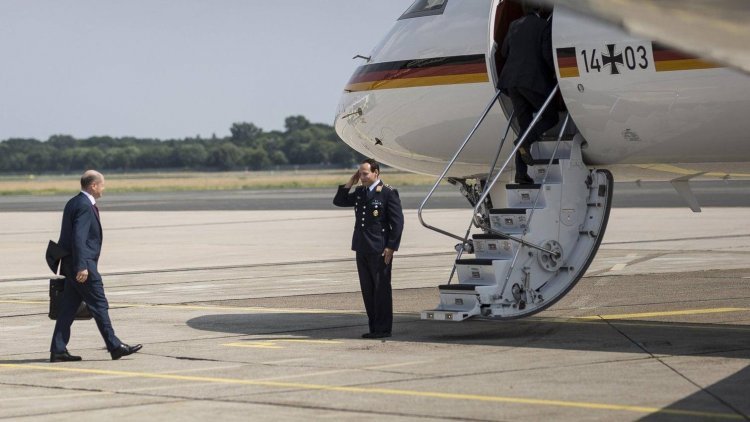
Despite all this, the contradictions of the EU have become a “registered trademark”, becoming more clearly than ever amid the storm of the current global crises: After the 27 European countries, including those closer to Beijing, such as Hungary agreed on the need to achieve greater independence from China, especially in sensitive sectors like advanced industries and the acquisition of infrastructure, we find German Counselor Olaf Scholz announcing a visit to China in early November. This will be the first visit by a Western leader since the end of 2019, when COVID-19 began to cast its shadow across the globe.
Scholz, who was finance minister under former Chancellor Angela Merkel, will be accompanied by a delegation of high-ranking figures from Germany’s financial, economic, and industrial sectors.
The ironically absurd aspect of this visit is that it comes shortly after a congress of the ruling Chinese Communist Party that broke with all past conventions, allowing the current president, Xi Jinping, to rule for life, after surpassing the commonly recognized retirement age of 68 for the party’s general secretary and being elected to a third five-year term. This implicitly means consolidating the pillars of his rule over China and adopting a more hardline approach on a number of domestic and international issues.
Not to mention that the German government may approve the acquisition by the Chinese company COSCO of one of the terminals at the Port of Hamburg, one of Europe’s largest and busiest ports, a decision that has not been warmly welcomed in Brussels.
Regarding Xi Jinping:
The man has done the unthinkable: he has eliminated all his political rivals who had been counting on a “quiet coup” against him, particularly his two competitors, the outgoing Prime Minister Li Keqiang and Wang Yang. The Central Committee of the Communist Party, which is essentially the ruling body of the country under the leadership of the General Secretary, includes 200 members, among whom Xi Jinping is present. However, the two individuals mentioned above are absent, meaning they have been directly retired.
Definitely, some may ask: what do we have to offer to secure a prominent place among the nations?
The answer: A lot, a lot more than you think, but you have not opened your eyes yet. Take Britain, for example, that island with limited resources. What does it have to offer other than being a safe haven for drug barons’ money, Russian oligarchs and exaggerated “afternoon tea”? Tell me what it has besides that, and you’ll win a prize.
I say:
In the midst of these conflicting stances and news, we have no choice but to turn inward. For years, I have been repeating that we, Arab nations and peoples, are on the brink of a short window of “chaos” that we must exploit to leave our mark and secure a better place among the nations. We must not settle for the “comfort zone” that we have accepted for ourselves over decades, and which we have further entrenched in culture, art, and literature.
Learn from them... to learn about them!
English Language Coordinator: Mariam Essa